
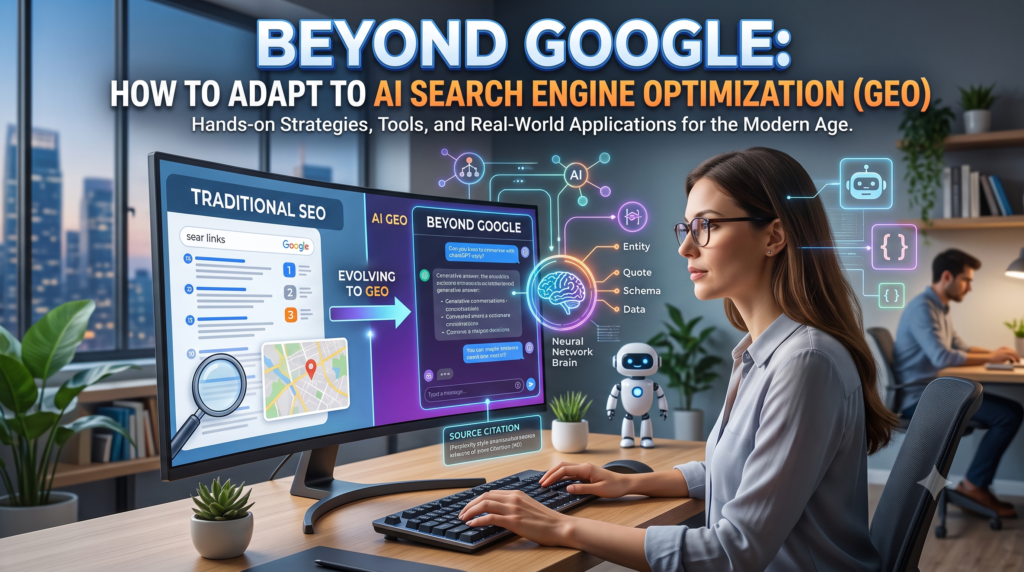
Beyond Google: How to Adapt to AI Search Engine Optimization (GEO)
Search engine optimization is undergoing its biggest transformation in two decades. Traditional search engine optimization focused heavily on backlinks, keyword density, and Google’s page rank algorithm. Today, AI search engine optimization—often called Generative Engine Optimization (GEO)—requires an entirely new playbook.
Here is what you need to know to make sure your brand remains visible when users search using conversational AI.
What is Generative Engine Optimization (GEO)?
While traditional SEO focuses on getting your link to position #1 on a search results page, GEO focuses on getting your content cited and summarized inside AI-generated answers.
| Traditional SEO | AI Search Optimization (GEO) |
| Focuses on blue links and SERP position | Focuses on direct AI citations & summaries |
| Keyword matching and keyword density | Semantic search and contextual depth |
| High domain authority and backlink volume | High factual accuracy and E-E-A-T signals |
Essential Strategies to Rank in AI Search Engines
1. Build Deep E-E-A-T (Experience, Expertise, Authoritativeness, Trust)
AI search engines favor content written by subject matter experts with real experience. Generic, surface-level content gets ignored.
Highlight Author Credentials: Include clear author bios detailing relevant industry experience.
Share First-Hand Data: Include original statistics, custom case studies, and proprietary research.
2. Format Content for Scannability & Direct Answers
AI models scan text for clear, direct answers to user queries.
- Place a concise answer (2–3 sentences) directly under every main heading (
H2/H3). - Use structured data markup (Schema.org) to clarify what your page is about.
- Use Markdown tables, bulleted lists, and clean structural dividers to organize complex information.
3. Answer Conversational Long-Tail Queries
People search differently using conversational AI. Instead of typing “best CRM tools,” they ask “What is the best light-weight CRM tool for a 5-person real estate agency?”
To target these searches:
- Structure content around natural, conversational questions.
- Include dedicated FAQ sections at the end of key articles.
4. Build a Strong Digital Footprint Off-Site
AI search models crawl across the web to verify facts. If your brand is mentioned across multiple authority websites, podcasts, and digital publications, AI models are far more likely to treat your brand as a primary source.
Summary Checklist for GEO Readiness
- [ ] Add clear author credentials to every post.
- [ ] Include original insights, data, or personal experience.
- [ ] Structure articles with clear headers, tables, and short summary answers.
- [ ] Implement FAQ Schema on high-priority pages.
Ready to Implement AI in Your Business?
Book a free consultation with Xhylo's AI experts and get a custom roadmap for your organization.
Book Free AI Consultation